


When I first started working in product, I thought “strategy” meant something complicated — a huge deck, a long meeting with executives, a bunch of frameworks, and a lot of abstract thinking.
But the more experience I gained, the more I realised something surprising:
Most good product strategies easily fit on one page.
And they’re not exclusive to senior leaders or “visionary” founders.
Any Product Manager can create a clear strategy, as long as they understand what strategy actually is.
It took me years to learn this the hard way, so I want to share it in the simplest possible form.
What product strategy really is (in my experience)
Strategy only feels intimidating when no one is able to define it clearly.
In reality, it comes down to a very simple idea: it’s a set of decisions that explain
what matters, why it matters, how you plan to approach it, and what you will consciously avoid doing:
It’s not your backlog.
It’s not your roadmap.
It’s not a collection of feature ideas.
It’s clarity — the kind that creates alignment and direction.
When I realised I needed a strategy
There were moments in my career where the product felt like it was moving forward, but not necessarily in the right direction. The roadmap kept expanding. Metrics weren’t improving. Stakeholders had different ideas about what we should prioritise.
And the team didn’t always share the same mental model of where we were going.
This is usually the turning point.
When movement exists but direction doesn’t — that’s when strategy becomes essential. It’s not about slowing down. It’s about choosing the right path before accelerating again.
The four parts that I use in every strategy
After trying dozens of frameworks, I came to a simple realisation:
Almost every strategy can be broken into four components.
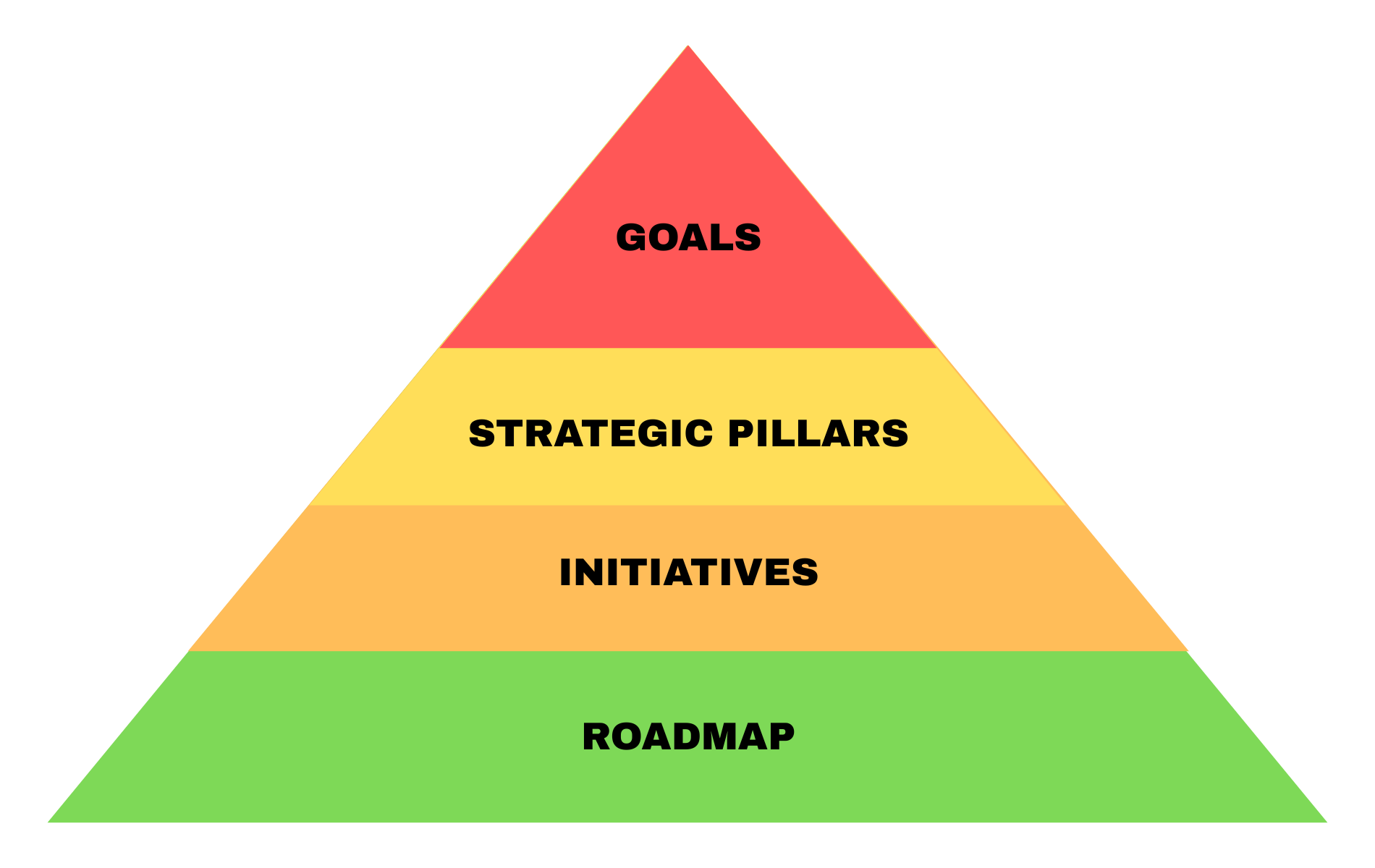
First, I define the outcomes we need - the goals.
Then I articulate the approach we’ll take - the strategic pillars.
Once the pillars are clear, they naturally turn into initiatives and actions.
And only then do I think about timelines - the roadmap.
Once I started thinking about strategy like this, everything became simpler.
I stopped overcomplicating things.
The most important metric I rely on
I’m a big believer in the North Star Metric — the one number that shows whether users are actually getting value.
Different companies pick different NSMs:
Spotify looks at listening time, Airbnb at nights booked, Slack at messages sent.
The NSM doesn’t replace strategy, but it keeps me honest.
Whenever I’m unsure whether something truly matters, I ask myself:
Does this move the North Star?
If the answer is no, the decision becomes easy.
Why strategy matters
Whenever I worked without a clear strategy, I noticed the same pattern:
I became reactive.
I focused on tasks instead of outcomes.
I responded to requests instead of shaping direction.
And even when we shipped a lot, it wasn’t always meaningful.
Strategy changed that for me.
If you want a simple way to start
I recently put together a free mini-course called Product Strategy Explained Simply.
It captures everything I’ve learned about building one-page strategies: a clean framework, a real example, a roadmap breakdown, and a Notion template you can start using today.
If you want to deepen your strategic thinking without drowning in theory, you’ll find it helpful.
👇👇👇
The four-layer framework actually works because it forces teams to connect abstract goals to concrete timelines. Most orgs fail when they skip the "pillars" layer and jump straight from goals to initiatives, which is why roadmaps feel random. This visual makes it obvious that strategy isn't about complexity but about having the discipline to link each layer properly.